
Wholesale or Off-the-Shelf? Sourcing a Body Care Scent Range
There are two ways to put a scented body care range on the market, and they look similar for the first month. You can buy a finished, ready-scented range from a supplier that already produces it, or you can commission a wholesale run in which the formula is developed and produced for you. The first route is faster and narrower; the second is slower and gives you something you own. Choosing between them is less about budget than about which of those two words matters more to the plan.
Key takeaways
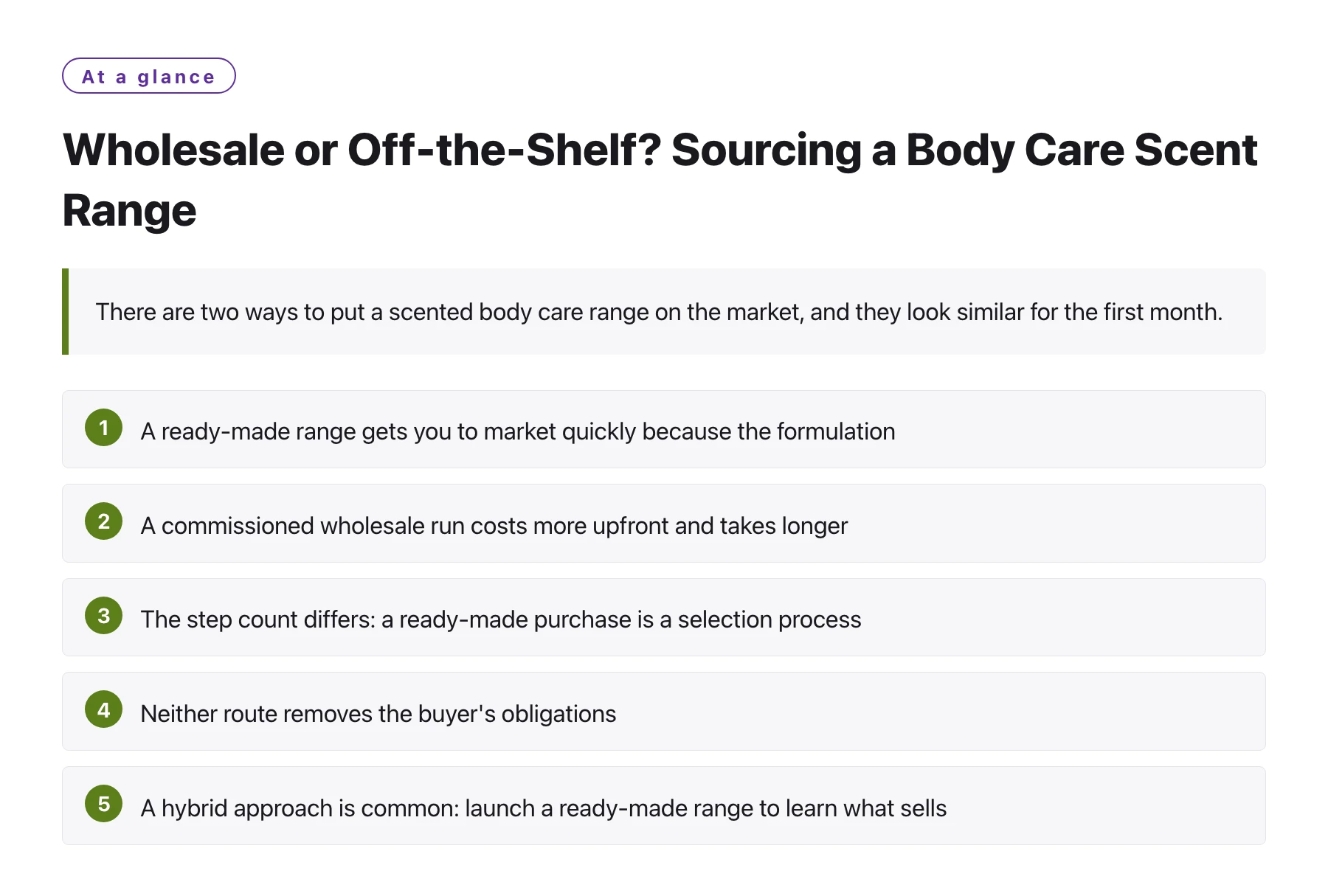
- A ready-made range gets you to market quickly because the formulation, packaging and testing already exist, and it stays available to other buyers as well.
- A commissioned wholesale run costs more upfront and takes longer, and it can produce a formula, a pack and a scent signature that are yours to extend.
- The step count differs: a ready-made purchase is a selection process, while a wholesale run is a development process with its own approval gates.
- Neither route removes the buyer's obligations, because labelling, claims and destination-market requirements sit with the brand on the shelf.
- A hybrid approach is common: launch a ready-made range to learn what sells, then commission development for the best-performing formats.
Small brands often arrive at this decision after a first attempt in the wrong direction. They commission development because it sounds more ambitious, then discover that a full run consumes a year and most of the budget. Or they buy a ready-made range because it is fast, then find that the same product appears under three other labels on the same shelf.
This article sets out both routes as processes, because the step sequence is where the real difference lives. It is written from the founder's seat, for the moment when a supplier list is open and the launch date is still negotiable.
Two routes that look similar at the start
Both routes begin with a search, a sample box and a shortlist. Both end with pallets arriving at a warehouse. What differs is everything in between: how many decisions you control, how long the calendar is, and what happens when the first range sells well and you want a second one.
The clearest way to choose is to work out what the business needs from the first order. If the answer is revenue and market information, the ready-made route is a rational choice. If the answer is a position that competitors cannot copy, the commissioned route is the only one that delivers it. Buyers comparing programmes that offer private label fragrance production should ask the same question of each: which decisions does this route take out of my hands?
Route one: buying a finished, ready-scented range
- Collect sample boxes from several suppliersRequest the full range rather than the bestseller, because your market may respond to a different format than the supplier's home market does.
- Confirm what the price includesCheck whether the figure covers the filled product, the carton, the label and delivery. Ready-made ranges are frequently priced ex-works with packaging quoted separately.
- Verify the documentation you will needAsk for the ingredient and safety documents that your destination market requires, and confirm who updates them if the formula changes.
- Check how many other buyers carry itA range sold to everyone is not necessarily a problem, but it changes the marketing plan. Ask directly whether the product is exclusive to you in any market.
- Plan the branding you can still controlLabel, carton, photography and copy remain yours even when the formulation is not. That is often enough differentiation for a first launch.
Route two: commissioning a wholesale fragrance run
- Write the brief before the first callFormat, base, dosage target, destination market and price ceiling. The brief is the document that keeps the development phase from doubling in length.
- Agree the development scope and termsHow many sampling rounds are included, whether the formula transfers to you, and how exclusivity is defined. Settle these while they are still optional.
- Approve the scent in the base, not only on paperBody care scent behaves differently in a wash and a lotion, so approval should be given against the finished application.
- Lock the formula and the pack togetherThe container, closure and label are part of the product's performance, so they should be frozen before the bulk run rather than after it.
- Run the first batch as a test of the processThe first wholesale order confirms that the formula can be repeated, the lead time is real and the paperwork matches what ships.
Where the two routes diverge
| Question | Ready-made range | Commissioned wholesale run |
|---|---|---|
| Time to first shipment | Weeks, because sampling is a selection rather than a development | Months, including sampling, application testing and a bulk run |
| Upfront cost | Lower, usually a purchase order with no development invoice | Higher, because development and testing are paid before production |
| What you own | The label and the brand, while the formula stays with the supplier | Whatever the agreement says, which can include the formula itself |
| Available to competitors | Yes, unless a limited exclusivity is negotiated | The scent and pack can be exclusive if the terms say so |
| Easiest next step | Add a format or a variant from the same supplier's list | Extend the range with a second development or a variant of your own |
Read the fourth row first. Everything above it is a scheduling question; the fourth row is the one that decides what the brand is worth in three years.
What to read before committing to a route
The two routes converge on one document, the brief, and they diverge on who writes it. On the ready-made route the brief is a selection; on the commissioned route it is the specification that development is measured against. That is why the launch plan is worth reading before the sourcing decision rather than after it: what it takes to launch a perfume brand is a reasonable guide for a founder weighing how much of the first year should go into product and how much into distribution.
Documentation obligations do not change with the route either. The brand on the label is responsible for what the label says, so the documents have to be collected either way, and the ingredient references behind them are published by the regulators rather than by the supplier [1]. Industry coverage of how household and personal care ranges are brought to market is another useful check on what buyers in your category are actually doing [2].
Choosing for the first year
For most first-time founders the honest answer is a sequence rather than a choice. Start with a ready-made range to find out which formats and scent families sell in your market, then commission development for the products that earned a second order. That sequence spends development money on evidence instead of on a guess.
Whichever route is chosen first, understanding the R&D process behind wholesale fragrances is worthwhile before the decision, because it shows which parts of a commissioned project can be shortened later and which cannot.
A single question sorts most of these decisions: if the range sells out in three months, what do you want to be able to do that a competitor cannot? The route that makes that possible is the right first route.
Sources
- EU CosIng — Cosmetic Ingredient Database (European Commission) —— The European Commission's CosIng database of cosmetic ingredients, listing ingredient functions, restrictions and labelling requirements under EU cosmetics law.
- HAPPI — Household & Personal Products Industry —— An industry magazine covering the household and personal care market, including fragrance, formulation and packaging.
Frequently asked questions
Is a ready-made body care range lower quality than a commissioned one?
Not inherently. Ready-made products are produced on the same kind of lines and can be perfectly well made. The difference is in control and exclusivity, not in an automatic quality gap.
How long does a commissioned wholesale fragrance run take?
It depends on the number of sampling rounds and the testing scope. Plan for a development phase measured in weeks to months, followed by a bulk production cycle whose length depends on the packaging and the format.
Can I start with a ready-made range and develop my own later?
Yes, and it is a common sequence. Use the first range to learn which formats sell, then commission development for the products that justify it. Keep the label and the brand consistent across both.
What should an exclusivity clause cover?
At minimum, the scent, the finished formula and the markets it applies to, plus a stated duration. Exclusivity in one country and not another is a normal arrangement, so the geography has to be written down.
Who is responsible for labelling a body care product?
The brand whose name appears on the pack. Suppliers can provide the ingredient and safety documentation, and the legal responsibility for the finished label stays with the brand.
اشترك في الموجز اليومي لـ Almasira
ملخص القضايا الإقليمية، يُسلَّم إلى بريدك قبل الساعة السابعة صباحاً بتوقيت الرياض.